Articles about Physics and the History of Physics
Articles about Physics and the History of Physics Colin Baxter
Table of Contents
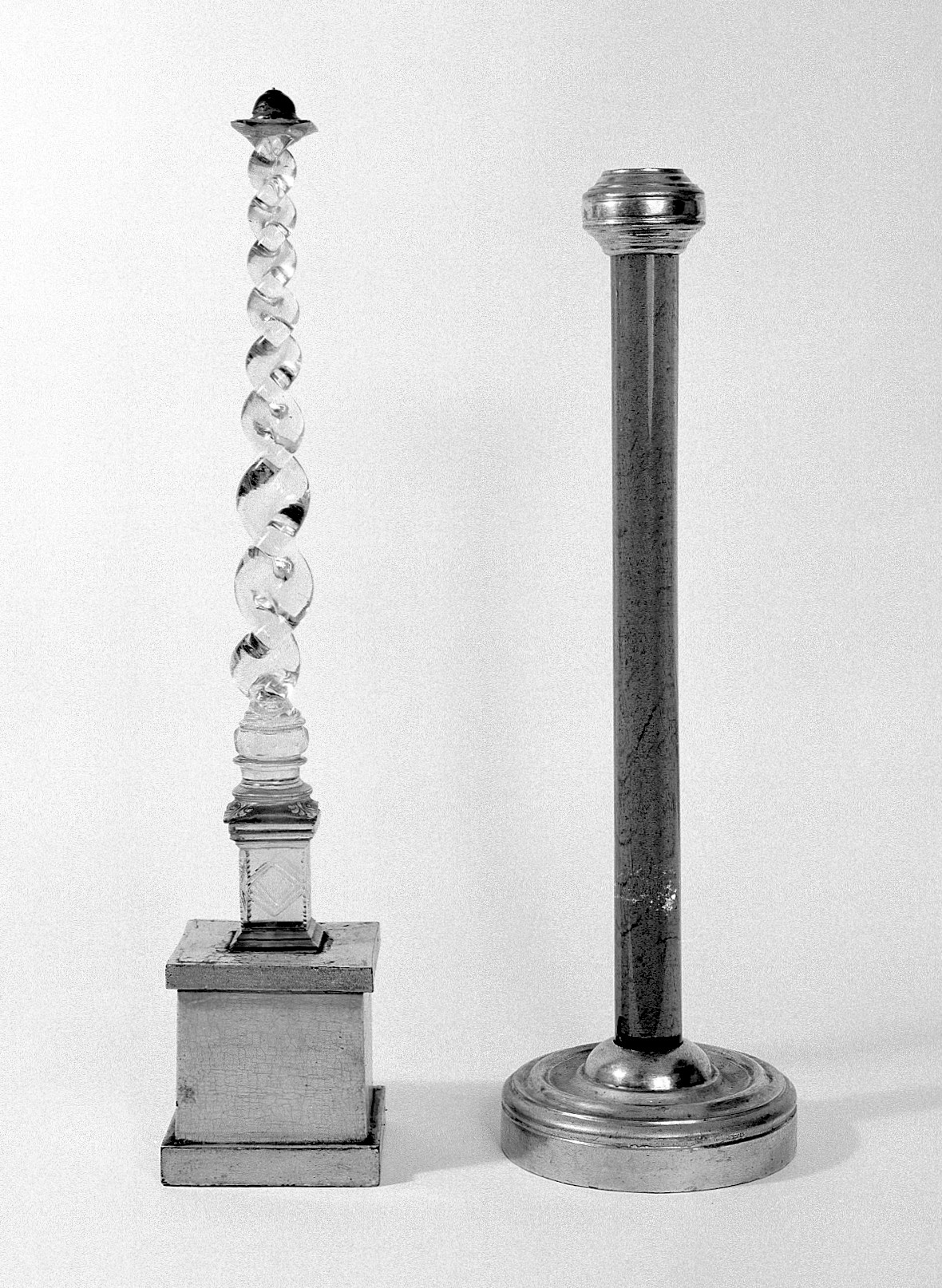
This page contains links to general articles on physics and its history. As explained at the top of the Home page, my academic research publications are elsewhere. The above picture is a detail of Solomon's Temple by Villalpando. Issac Newton seems to have been much impressed by Villalpando's writings.
Leviathan Against the Air Pump
The dispute between Robert Boyle (1627-1691) and Thomas Hobbes (1588-1679) was a key event in the history of science. Although ostensibly about the nature of the vacuum, the dispute was fundamentally an argument about how useful knowledge might be obtained.
The Pendulum Clock and the Quest for Precision
Galileo Galilei, according to legend, discovered the isochronism of the pendulum while observing a swinging lamp in the cathedral of Pisa. This principle—that the period of a pendulum is independent of its amplitude for small oscillations—opened the door to precise timekeeping. Before the pendulum clock, mechanical clocks were inaccurate by many minutes per day, making them useless for scientific work. The pendulum reduced errors to seconds per day, a thousandfold improvement that transformed astronomy, navigation, and experimental physics.
Christiaan Huygens built the first practic, incorporating an escapement mechanism that sustained the pendulum’s motion while allowing the gear train to advance in regular steps. His design quickly spread across Europe, and pendulum clocks became the backbone of astronomical observatories. With reliable time, astronomers could measure stellar positions more exactly, leading to the discovery of phenomena such as stellar aberration and the proper motion of stars.

The pendulum clock also played a crucial role in the determination of longitude at sea. Although pendulum clocks were too sensitive to ship motion to be used directly, the precision they brought to land-based observatories allowed mariners to check their marine chronometers against an absolute standard. The quest for ever more accurate pendulums drove investigations into thermal expansion, air resistance, and the elasticity of suspensions. These studies fed back into pure physics, shaping the early understanding of damped harmonic oscillators.
Maxwell’s Demon: Entropy and Information
James Clerk Maxwell, famed for his unification of electricity and magnetism, also contributed a profound thought experiment to thermodynamics. In his 1867 letter to Peter Tait, Maxwell imagined a tiny being—later called a ‘demon’ by Lord Kelvin—that could see individual molecules and operate a frictionless door between two chambers of gas. If the demon opened the door only for faster molecules to pass one way and slower ones the other, the temperature difference between the chambers would increase, apparently violating the second law of thermodynamics without any work being performed.
This paradox troubled physicists for decades, because it suggested that a sufficiently intelligent agent could circumvent the statistical decline of usable energy. The resolution came only in the twentieth century, when Leó Szilárd and later researchers linked the demon’s actions to information. To sort molecules, the demon must acquire information about their positions and velocities, and the erasure of that information from the demon’s memory carries a thermodynamic cost. In a foundational 1961 paper, Rolf Landauer showed that logical irreversibility implies a minimum heat dissipation per lost bit, and Charles Bennett later demonstrated that the demon’s total entropy reduction is exactly offset by the entropy generated when its memory is cleared.
Maxwell’s demon thus illuminated the deep connection between information and physics, a theme that now pervades quantum computation, black hole thermodynamics, and the study of complex systems. The thought experiment remains a vivid example of how a simple challenge to a fundamental law can open up entirely new fields of inquiry.
The Discovery of the Electron: J.J. Thomson’s Experiments
By the late nineteenth century, cathode rays were the subject of intense investigation. Some physicists, following the German school, believed the rays were a form of electromagnetic wave; others, led by British experimenters, argued they were streams of charged particles. The controversy was settled by a series of experiments conducted at the Cavendish Laboratory in Cambridge under J.J. Thomson. In 1897, Thomson measured the charge-to-mass ratio of the particles in cathode rays by balancing electric and magnetic deflections. He found that the ratio was over a thousand times larger than that of hydrogen ions, implying that these corpuscles were either extraordinarily tiny or extraordinarily highly charged.
Thomson proposed that cathode rays were composed of negatively charged particles, which he called ‘corpuscles’ and which later became known as electrons. He further showed that these particles were identical regardless of the gas in the discharge tube or the metal of the cathode, suggesting they were a universal constituent of matter. Thomson’s work overturned the notion that the atom was indivisible and laid the foundation for the electronic age.
Within a few years, the electron became central to the development of both atomic physics and practical technologies. It provided the key to understanding the photoelectric effect, the Zeeman effect, and the conduction of electricity in metals. Thomson’s student Ernest Rutherford used the electron to probe the structure of the atom, leading to the nuclear model. By identifying the first elementary particle, Thomson inaugurated a new era of fundamental physics that continues to this day.
The Michelson–Morley Experiment and the Luminiferous Ether
Throughout the nineteenth century, physicists accepted the existence of a luminiferous ether—an invisible, all-pervading medium that carried light waves, just as air carries sound. If this ether were stationary, the motion of the Earth through it should create an ether wind detectable by optic, Albert A. Michelson and Edward W. Morley, working at what is now Case Western Reserve University in Cleveland, set out to measure this relative motion using an interferometer of exquisite sensitivity.
Their apparatus split a beam of light into two perpendicular paths, reflected them back, and recombined them to produce interference fringes. Any shift in the fringes as the instrument was rotated would reveal the Earth’s velocity through the ether. Despite meticulous precautions to eliminate vibrations and thermal effects, Michelson and Morley consistently found no detectable fringe shift. The null result was a profound shock to the physics community, as it contradicted the straightforward expectation of ether drift.
Explanations proliferated: some suggested that the Earth dragged the ether along, but that conflicted with measured stellar aberration. George FitzGerald and Hendrik Lorentz independently proposed that moving objects contract in the direction of motion, a purely ad hoc hypothesis at the time. It was left to Albert Einstein in 1905 to reinterpret the null result not as a failure of the experiment but as evidence that the very concept of an absolute ether was superfluous. By postulating the constancy of the speed of light for all observers, Einstein laid the foundations of special relativity, arguably the most important conceptual shift in modern physics.