Articles about Heraldry

Articles about Heraldry Colin Baxter
Table of Contents
My interest in heraldry began as a child when I spent my time painting dreadfully bad pictures of coats-of-arms. I still paint bad pictures, but now they are seasoned with interests in fictitious-iconography, heraldry as political and social history, and technical aspects of blazon. The above picture is of a golden lion lying on the ground with its head up, displaying a red tongue and sliver claws. That is, a lion couchant or, langued gules and armed argent. This is an unusual lion; normally, an heraldic lion is armed and langued gules — its claws as well as its tongue are red.
The Virgin Mary as the Arms of King Arthur
Many writers on Arthurian heraldry and literature mention that King Arthur used a depiction of the Virgin Mary as his coat-of-arms. The ultimate authority of this claim is the Historia Brittonum, which is usually said to have been written or compiled by Nennius, a supposed Welsh monk who lived in the Ninth Century. The Historia Brittonum, however, is not a definitive document: it exists in several different non-contemporary manuscripts and there are at least ten known recensions and translations.
The Sempill Arms: Heraldic Puzzles
The Collegiate Church of Castle Semple lies close to Lochwinnoch in southwest Scotland. The building is now a shell open to the sky but it houses two interesting and puzzling examples of monumental heraldry which seem to have gone largely unnoticed. These examples and the questions they raise will be discussed individually later in this article.
The Gawain Problem
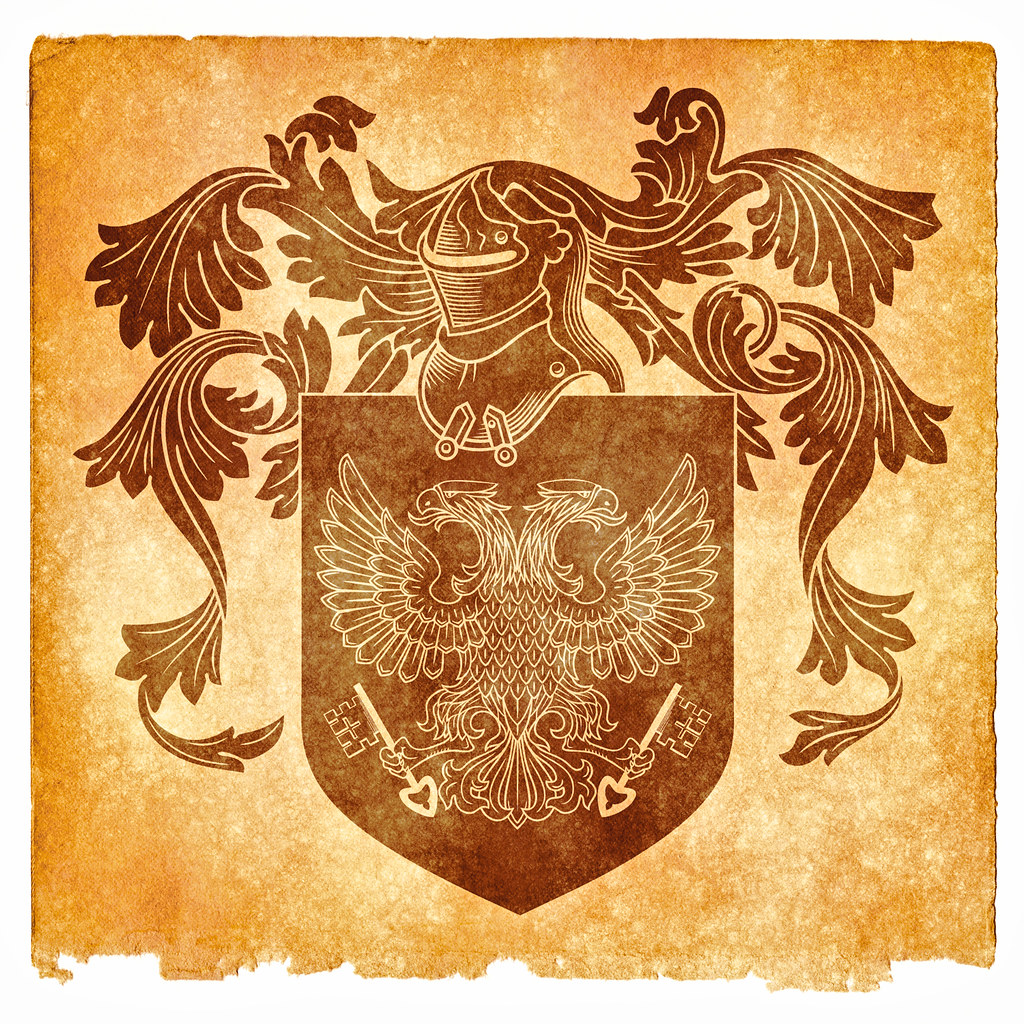
Gawain, a major character of Arthurian romance poses a special challenge in Arthurian heraldry in that more than one distinctive set of arms are attributed to him. French romances of the Thirteenth Century give Gawain's arms consistently as argent, a canton gules, but by the Fifteenth and Sixteenth Centuries this appears to have changed to purpure, a double-headed eagle or. While it is not unusual for knights of medieval romances, or indeed real knights, to have carried more than one set of arms, the fact that there appears to have existed two well-defined traditions of attributing different arms to the same character is unique.

A Statistical Analysis of the Dering Roll
The Dering roll is a list of knights together with blazons of their coats-of-arms. It is thought to date from about 1280 and the knights are predominantly those of Kent and Sussex. Using org-mode, a software package written in emacs-lisp, we have constructed a simple interrogatable database of the Roll.
The Art of Blazon: Precision and Poetry
Blazon, the specialized language used to describe coats-of-arms, is both a rigid technical system and a surprisingly poetic medium. Its syntax follows strict conventions: the field is described first, then the principal charges, and finally the minor details, all in a Norman-French derived vocabulary that has remained largely unchanged since the thirteenth century. This consistency allows a herald to reconstruct a visual design from words alone, a necessity when many arms were known only through written records. The precision required is absolute; a misplaced comma or a misordered term can produce a completely different shield. Yet within its constraints, blazon achieves a concise elegance, packing layers of meaning into a single phrase. For instance, the seemingly simple blazon "azure, a bend argent" immediately conveys a blue shield with a diagonal white band, but it also carries assumptions about proportions, line style, and the absence of other charges. The discipline of blazon is not merely descriptive—it is prescriptive, dictating exactly how an armorial bearing should be depicted.
Understanding blazon unlocks the hidden grammar of heraldry and reveals the meticulous logic behind what might otherwise appear as arbitrary decoration. The language has its own quirks: colors and metals are named in Old French (or, argent, gules, azure, sable, vert, purpure), and attitudes of beasts (rampant, passant, couchant) follow a set order. Over centuries, regional variations have emerged, but the core system remains universal across Western heraldry. For the heraldic enthusiast, learning to blazon is akin to learning a new language—one that opens a direct line to the medieval mind and its love of ordered symbolism.
Heraldic Beasts: Lore and Legend on the Shield
The menagerie of heraldry extends far beyond the familiar lion and eagle. While the lion, in its many attitudes, reigns as the most common beast, the heraldic bestiary is filled with creatures both real and fantastic. The stag, the boar, the wolf, and the bear each carry their own symbolic weight, often derived from bestiary traditions or local folklore. More exotic real animals like the camel, the elephant, or the dolphin appear in arms connected to trade or distant lands. But it is the mythical beasts that capture the imagination: the griffin, combining the eagle and lion, symbolizes courage and vigilance; the wyvern, a dragon with only two legs, represents pestilence and conquest; the cockatrice, a serpent-tailed rooster, strikes fear as a symbol of basilisks. These chimerical creatures were not merely decorative—they conveyed specific messages about the bearer’s lineage, temperament, or aspirations.

The attitudes in which beasts are depicted form another layer of meaning. A lion rampant, rearing on one hind leg, projects aggression and martial prowess, while a lion passant, walking with one forepaw raised, suggests calm authority. The couchant posture, lying down with head erect, as mentioned in the introductory anecdote about the golden lion, evokes a regal but resting vigilance. Lesser-known attitudes like "segreant" (applied to griffins) or "salient" (leaping) add precision. Understanding these postures, and the subtle variations like "guardant" (facing the viewer) or "regardant" (looking backward), is essential to appreciating the narrative quality of heraldic art. Each shield becomes a snapshot, freezing a creature in a moment of characteristic action.
Heraldry in Fiction: Blazoning the Imaginary
From the Arthurian romances to modern fantasy literature, heraldry has been an indispensable tool for world-building. Fictional coats-of-arms lend authenticity and depth to imagined societies, signaling alliances, rivalries, and personal traits. Authors like J.R.R. Tolkien and George R.R. Martin employed intricate systems of heraldry to enrich their narratives, drawing on the real-world rules of blazon to create believable symbols. In Tolkien’s Middle-earth, the white tree of Gondor and the seven stars are more than decorative devices; they embody the history and hope of a kingdom. Similarly, the sigils of the Great Houses in Martin’s Westeros—the direwolf of Stark, the lion of Lannister—function as shorthand for the characters’ natures and fates. Crafting such arms requires a delicate balance: they must obey enough heraldic conventions to feel credible, yet remain evocative and original.
The fascination with fictitious heraldry extends beyond literature into role-playing games, film, and even personal online avatars. Designers often face the challenge of avoiding anachronism while still tapping into the rich visual tradition. A well-designed fictional coat-of-arms might employ standard tinctures and ordinaries, but with charges that reflect the unique mythology of its world. For instance, a phoenix rising from a starry field could symbolize rebirth in a cosmic setting. The key is consistency: once a set of heraldic rules is established for a fictional universe, they should be applied with the same rigor a real herald would exercise. This not only pleases enthusiasts but also deepens the immersion for all who encounter these imagined worlds.
The Dering Roll: Insights from Statistical Analysis
Though a previous article introduced a statistical examination of the Dering Roll, a closer look reveals fascinating patterns in the armorial landscape of late thirteenth-century England. The roll, containing over 300 entries, provides a rare snapshot of the armorial bearing of the knightly class in Kent and Sussex around 1280. By cataloging the occurrence of various charges, we can discern regional preferences and fashions. Lions, perhaps unsurprisingly, dominate, but their frequency and the specific attitudes used can be charted. Equally telling is the distribution of ordinaries—geometric patterns like bends, fesses, and chevrons—which appear on a significant proportion of shields, often serving as the only charge. The relative popularity of colours and metals also offers clues; for example, the combination of gold and red (or and gules) appears with notable regularity, perhaps reflecting its visual impact or symbolic potency.
Beyond mere counting, statistical analysis can illuminate social connections. The recurrence of certain charges within families, or the echoing of a lord’s arms in the modified shields of his retainers, reveals the mechanisms of feudal loyalty and identity. The Dering Roll, with its concentration on a specific region, allows us to glimpse a network of knights whose arms spoke to their allegiances. Such data-driven approaches complement traditional heraldic scholarship, offering new ways to interpret the symbolic language that these men wore into tournament and battle. The database created using org-mode facilitates these inquiries, enabling queries that would have been painstakingly slow with printed sources.